

Welcome to the Davis Tree Service blog! As your local tree care experts in Montgomery County, Texas, we’re passionate about helping homeowners keep their trees healthy, safe, and beautiful. In this article, we’ll share practical, site-tested tips for tree care specifically tailored to Montgomery, TX and the surrounding area—and explain exactly how Davis Tree Service can assist you with professional solutions.
Whether your goal is to maximize shade, reduce storm risk, or simply enjoy more vibrant landscaping, our goal is to equip you with knowledge—and to be your trusted partner in tree care. Visit our home page at https://www.davistreellc.com/ to learn more about our expertise.
Understanding the Montgomery, TX Environment and Its Challenges
Before diving into tips, it helps to know what makes tree care in Montgomery, TX unique. Local climate, soil type, and native species all influence what trees thrive — and what risks they face.
-
Montgomery County sits in Southeast Texas, where hot, humid summers, occasional droughts, and sudden storms are common.
-
Soils vary, but many properties have clay or heavy soils, which can hamper root growth and drainage.
-
Native and adapted tree species (oaks, pecans, maples, live oak, bald cypress, etc.) tend to fare better than exotic or over-delicate trees.
-
Young trees are especially vulnerable in their first few years, needing thoughtful watering, staking, and protection.
-
Storms (wind, lightning, hail) and pests/diseases (fungal issues, insect attack) are persistent threats.
Knowing that, let’s dive into our recommended practices.
1. Proper Watering: Deep, Infrequent, Targeted
One of the biggest mistakes we see is overwatering or shallow watering. Here’s how to do it right:
For New and Young Trees (0–3 Years)
-
Aim for roughly 25 gallons of water per week, especially during the growing season.
-
Instead of sprinkling superficially, apply water slowly at or just beyond the drip line (1–2 ft from the trunk) using a soaker hose or drip line.
-
If your soil is heavy (slower to absorb), water more slowly to avoid runoff.
-
Remove stakes after about one year so the tree can flex in the wind and establish stronger roots.
For Established Trees
-
Once trees are mature, they usually only need deep watering during drought periods (e.g. once every few weeks) rather than regular weekly watering.
-
When watering, wet the entire root zone—go deep (6–8+ inches) rather than just wetting the surface.
-
Avoid keeping the soil soggy continually, which leads to root rot or fungal issues.
Watering is one of the simplest steps, but also one of the most critical. Done right, it improves root growth, disease resistance, and drought resilience.
2. Mulching: The Essential Layer
Mulch is like a protective blanket for your trees. When done properly, it offers multiple benefits:
-
Helps retain soil moisture (critical in hot months).
-
Suppresses weeds and grass competition near the base of the tree.
-
Moderates soil temperature swings (cooler in summer, warmer in winter).
-
Adds organic matter to the soil as it decomposes.
Best practices:
-
Use organic mulch (wood chips, bark mulch, shredded mulch)—not rock or rubber.
-
Spread a 2–3 inch layer, extending out to or slightly past the drip line of the tree (but not excessively far).
-
Leave a “mulch donut” — a gap of several inches around the trunk (no mulch touching the bark) to prevent fungal problems, bark rot, or moisture wicking into the trunk.
-
Replenish mulch periodically (once a year or more) as it breaks down.
3. Pruning & Trimming: Timing, Technique, and Safety
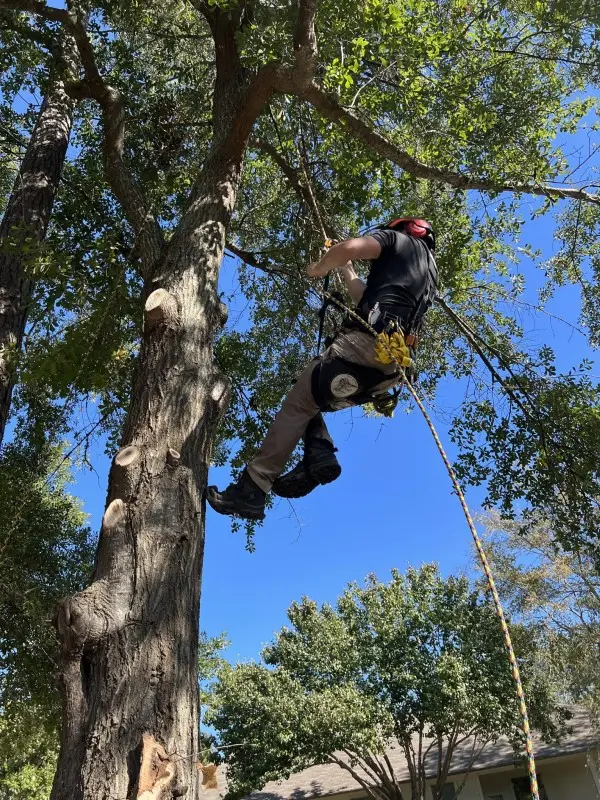
Proper pruning is both science and art. Poor cuts or ill-timed trimming can do more harm than good. Here’s what we recommend:
When to Prune
-
Dormant season (late winter) is typically the safest time for structural pruning of many species.
-
Avoid pruning oaks and elms during warm months, which can increase the risk of infection such as oak wilt.
-
Remove dead, diseased, or crossing branches whenever you spot them, even off-season—those are risks.
How to Prune
-
Always cut just outside the branch collar (do not flush-cut into the trunk).
-
Avoid large flush cuts or stub cuts.
-
Use proper pruning hierarchy: first remove dead/damaged branches, then thinning cuts to improve structure, and lastly shaping for aesthetics or clearance.
-
Do not remove more than ~25% of the canopy per year on mature trees—heavy pruning stresses trees.
-
Clean your pruning tools (sterilize between trees) to prevent spreading disease.
Consider Professional Trimming & Safety
Some pruning jobs involve risk: limbs over roofs, powerlines, steep slopes, or large heights. That’s where our experienced arborists at Davis Tree Service step in. We follow ANSI A300 pruning standards, use proper safety gear, and know how to shape trees to promote long-term health.
4. Fertilization & Soil Nutrition: When and How
Trees often go without fertilizer because they’re relatively self-sustaining — but in certain soils (especially clay or low-nutrient sites), supplementation helps.
-
Test the soil first to identify nutrient deficiencies (nitrogen, phosphorus, potassium, micronutrients).
-
Apply slow-release, tree-safe fertilizer in early spring or late fall (not in the peak heat).
-
Use deep root injection or soil-applied granular formulas for mature trees; use lighter doses for young trees.
-
Avoid overfertilizing, which can burn roots or disrupt microbial soil life.
5. Pest, Disease & Risk Monitoring
Montgomery’s climate and soils present opportunities for insect pests, fungal issues, and mechanical stress. Regular monitoring and early interventions are key.
Watch for Common Issues
-
Insect pests: borers, scale, aphids, beetles.
-
Fungal diseases: leaf spot, powdery mildew, root rot.
-
Stress symptoms: sparse foliage, dead branches, unusual leaf discoloration.
-
Structural defects: weak crotches, included bark, excessive leaning.
Preventative Actions
-
Ensure good air circulation in the canopy (thinning helps).
-
Avoid injuring the trunk or roots (mower/damage wounds invite pathogens).
-
Use disease-resistant varieties when possible.
-
Promptly remove dead or diseased wood to prevent spread.
Professional Care & Treatment
When pests or disease issues arise, professional diagnosis is essential. Davis Tree Service can inspect, recommend treatment plans, and implement safe solutions.
6. Selecting, Planting & Establishing Trees Wisely
The best tree is one planted right for the site — that way, after a few years, it thrives with minimal intervention.
Species Selection
-
Favor native or adapted species suited for local clay soil, heat, and occasional drought.
-
Avoid species known to be disease-prone in this region.
Proper Planting Technique
-
Dig a planting hole 2–3 times the width of the root ball, but not deeper.
-
Position the root flare at or slightly above grade (don’t bury it).
-
Backfill with native soil (don’t over-amend), and settle gently to remove air pockets.
-
After planting, water thoroughly and apply appropriate mulch.
Initial Care & Protection
-
Stake only if necessary, and allow movement. Remove stakes after a year.
-
Protect trunk from damage (weed trimmer, mowers, animals).
-
Monitor for water stress or competition from grass/weeds.
-
Prune minor growth during early years to guide structure.
7. Storm Readiness & Risk Mitigation
Montgomery, TX faces occasional storms, wind events, lightning, or hail. Taking proactive steps reduces damage risk.
-
Inspect trees for weak branches or structural defects.
-
Prune back limbs hanging over structures, driveways, or power lines.
-
Provide cabling or bracing if a tree has multiple weak trunks.
-
After storms, hire professionals to assess compromised limbs or hanging hazards.
-
Don’t attempt risky removals yourself—falls and accidents are real dangers.
Davis Tree Service offers emergency tree assessment and removal to help you recover safely from storm damage.
How Davis Tree Service Helps — Our Services & Promise
You shouldn’t have to tackle large tree projects or pest outbreaks on your own. At Davis Tree Service, we bring expertise, safety, and local know-how to every job in Montgomery County. Here’s how we support your tree health journey:
Our Services
We offer a full spectrum of professional tree care services, customized for your yard and your trees. Learn more on our Services page: https://www.davistreellc.com/services
We provide:
-
Tree trimming & pruning — structural pruning, maintenance trimming, clearance trimming
-
Tree removal — safe removal of hazardous or unwanted trees
-
Stump grinding & removal — to improve safety and aesthetics
-
Cabling & bracing — for trees needing structural support
-
Root collar excavation & root care — especially for older or stressed trees
-
Emergency tree services — storm damage cleanup, urgent removal
-
Consultation & assessments — diagnosis, treatment plans, preventative care
Why Choose Us
-
We are licensed, insured, and professional — giving you peace of mind.
-
Our team is led by a Certified Arborist (Ryan Davis), ensuring we apply industry-standard best practices.
-
We use modern equipment and methods to minimize impact to your property.
-
We offer free estimates and transparent quotes upfront.
-
We know the Montgomery, TX area intimately — soils, species, storm patterns — and tailor our work accordingly.
-
Safety is non-negotiable: for your home, trees, and our crew.
How We Work With You
Here’s what to expect when you contact us:
-
Initial consultation & inspection — we visit your property, inspect your trees, and discuss your needs.
-
Tailored proposal — we provide a detailed plan, cost, and scheduling.
-
Safe, professional execution — with cleanup and respect for your landscape.
-
Follow-up & maintenance — periodic checkups or scheduled pruning as needed.
Seasonal Tree Care Checklist for Montgomery Homeowners
To help you manage care throughout the year, here’s a seasonal checklist:
| Season | What to Focus On | Key Actions |
|---|---|---|
| Late Winter / Early Spring | Structural pruning, inspecting after winter | Prune dead/damaged limbs, open up canopy, schedule fertilization, check stakes |
| Spring / Early Summer | New leaf growth, watering, pest watch | Deep watering, mulch refresh, scout for pests/disease, minor pruning |
| Summer / Mid Season | Heat stress & drought management | Deep watering during drought, monitor soil moisture, avoid heavy fertilization |
| Late Summer / Early Fall | Prepare for storms, nutrient needs | Prune weak branches, inspect for damage, fertilize if needed in early fall |
| Winter (Dormant) | Minimal pruning, planning, inspections | Only prune dormant-safe species, plan for next year, inspect bark or structural damage |
Conclusion & How to Get Started
Caring for trees in Montgomery, TX doesn’t have to be intimidating. With the right practices—deep watering, correct pruning, mulching, vigilant monitoring—and a reliable arborist team at your side, your trees can thrive for generations.
If you’d like us to inspect a tree, prune a high limb, remove a hazard, or simply consult on tree health, we’re ready to help. Start by getting a free estimate on https://www.davistreellc.com/, or explore our full range of professional offerings via https://www.davistreellc.com/services.
Thank you for trusting Davis Tree Service. Let us help your trees grow stronger, safer, and more beautiful in the years ahead.