Welcome to Davis Tree Service, LLC — your trusted partner for professional cabling and bracing solutions in Montgomery County, Texas. This article dives deep into what cabling and bracing are, why they matter, how we install them, and how to tell when your trees need reinforcement. Learn more about who we are and see real-world examples in our gallery.
Table of Contents
What Is Cabling & Bracing?
Cabling and bracing are proven arboricultural techniques used to mechanically support and stabilize trees when natural structural weaknesses make them vulnerable to failure. By installing flexible cables and braces, arborists provide additional support to heavy, weak, or damaged limbs, helping reduce the risk of branch failure, tree splitting, or uprooting — especially under heavy wind, storms, or other stress.
-
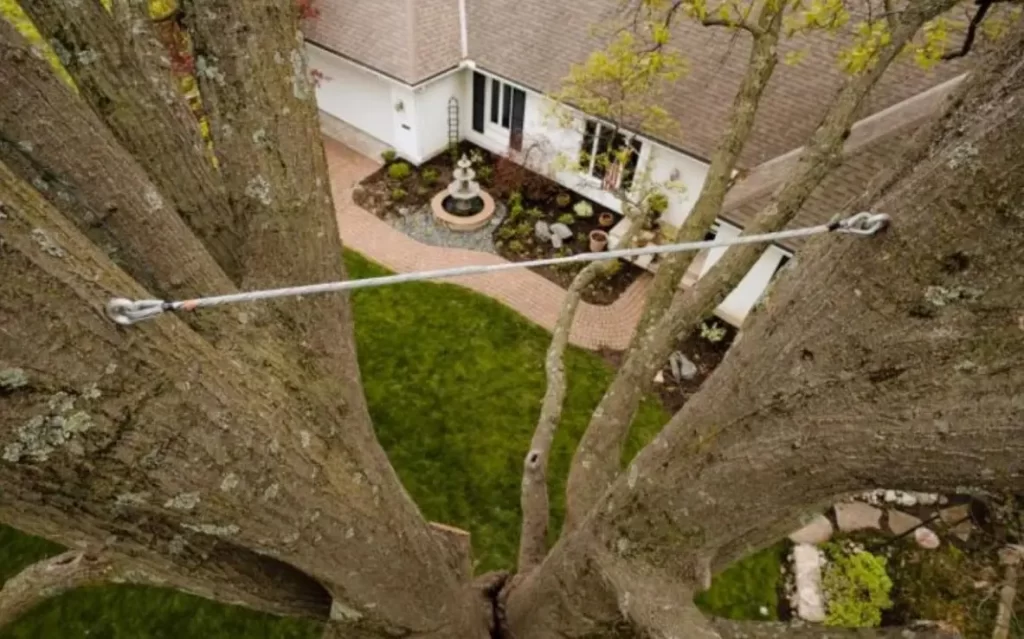
Cabling involves anchoring flexible steel or synthetic cables between major limbs or trunks, allowing them to move slightly while sharing load and reducing stress.
-
Bracing uses rods or braces to reinforce splits or weak points within a tree’s structure, often installed across cracks, splits, or codominant stems.
These systems are typically installed high in the canopy, where the risk of limb failure is greatest, to reduce the strain on vulnerable branches and maintain a healthier, more stable tree structure over time.
Why Cabling & Bracing Matters in Montgomery, TX
Montgomery, Texas, presents unique environmental factors that make cabling and bracing especially important for protecting trees and properties:
-
Severe Weather: Montgomery County is no stranger to storms, heavy winds, and occasional tropical systems. Trees with structural defects are more likely to suffer major damage or fail during strong wind events or heavy rains. Proper cabling and bracing can dramatically reduce this risk by helping limbs better withstand force and wind stress.
-
Urban and Residential Settings: As homes and neighborhoods grow, trees in Montgomery increasingly border houses, driveways, power lines, and public spaces. Unstable limbs pose a serious hazard to people, property, and infrastructure. Cabling and bracing offer a way to preserve mature trees safely rather than removing them preemptively.
-
Protecting Tree Health and Value: Many property owners prefer to preserve their trees instead of remove them. Cabling and bracing can save structurally flawed trees that would otherwise be at risk of splitting or failure, maintaining canopy cover, shade, and aesthetic value without compromising safety.
-
Cost-Effective Risk Management: By proactively addressing structural issues, homeowners can avoid costs associated with tree failure — including damage to homes, vehicles, fences, and landscaping, plus costly emergency removals and cleanups. Cabling and bracing represent an investment in long-term tree stability and safety.
When to Use Cabling & Bracing
Cabling and bracing are appropriate in a number of scenarios, particularly when trees exhibit one or more of the following conditions:
-
Codominant stems — when two or more large stems grow in close proximity and create a weak union or V-shaped crotch, increasing the risk of splitting.
-
Cracks, splits, or weak union sites within the trunk or large limbs that show signs of structural compromise.
-
Heavy limb loads, especially in trees with large, spreading canopies, those with heavy fruit loads, or limbs with significant deadwood.
-
Prior storm damage or limb decay, which may have weakened trunk or branch structure.
-
Historic or large shade trees that hold significant value but are showing early signs of structural instability.
-
Trees located near homes, driveways, walkways, or power lines, where limb failure would pose a substantial hazard.
However, cabling and bracing are not always the best solution. In some cases, structural defects are too severe, decay is too advanced, or the risk is too high — in those cases, removal might be safer.
At Davis Tree Service, we always conduct a full risk assessment to determine whether cabling and bracing are appropriate, or whether removal or other corrective pruning would be safer and more effective.
Our Cabling & Bracing Process
At Davis Tree Service, our cabling and bracing process follows a systematic, best-practice approach designed for safety, tree health, and long-term stability:
-
Site & Tree Evaluation
Before any hardware goes in, we perform an on-site inspection to evaluate tree structure, limb condition, decay, cracks, union strength, wind exposure, and overall risk. This step helps us determine if cabling and bracing will actually improve tree safety and longevity, or if removal is a better choice. -
Risk Assessment and Treatment Plan
Based on our evaluation, we develop a comprehensive treatment plan that includes recommendations — not only for cabling and bracing but also for pruning, decay treatment, or root care if needed. Our plan focuses on balancing tree preservation with safety. -
Hardware Installation
Using high-quality, industry-standard hardware (cables, bolts, braces, and anchors), we strategically install support systems designed to reduce stress on weak stems. Our installation methods follow ANSI A300 and Z133 standards, ensuring that cables and braces are placed optimally and do not damage the tree. Installation generally involves drilling into or through limbs, installing anchor bolts or plates, and attaching cables or braces to redistribute load.
We take care to minimize wounding to the tree and to install cable systems that allow for natural movement, rather than rigid restraint. -
Complementary Pruning
Where appropriate, we prune dead, weak, or competing branches to reduce weight, wind resistance, and stress on the tree. This reduces the load on the cabling system and improves overall tree structure and health. -
Post-Installation Monitoring
After a cabling and bracing system is installed, it’s important to inspect and monitor it regularly. Over time, cables can loosen, bolts can shift, or tree growth can change the dynamics of load. We recommend periodic inspections — often on an annual or biannual basis — to ensure the system remains effective and safe. -
Adjustment and Maintenance
If inspections reveal loosened hardware, friction wear, or structural changes in the tree, we adjust or replace cabling components as needed. This ensures that the support system continues to function properly and does not damage the tree. -
Long-Term Tree Health Monitoring
Even with a cabling system in place, trees must be monitored for decay, insect damage, root stability, and other health issues. Maintaining tree health through proper pruning, root care, and pest/disease management is critical to ensuring the success of any cabling project.
Signs Your Tree Needs Cabling or Bracing
Knowing when to call for cabling or bracing is key to preserving your trees safely. Here are warning signs to look out for:
-
Visible cracks or splits in major limbs or forks of a tree.
-
Creaking or popping sounds during windy conditions, which may indicate internal stress or branch movement.
-
Unusual leaning or movement in a tree after storms or heavy rain.
-
Cavities or decay near union points or in large limbs.
-
Heavy limbs extending over structures, driveways, or walkways that could fail.
-
Codominant stems without strong bark ridge or central leader.
-
Evidence of past limb failure or branch breakage in similar trees nearby.
-
Reduction in foliage or branch dieback near structural defects.
If you notice any of these signs, it’s wise to schedule a professional tree risk assessment. Davis Tree Service, LLC can evaluate your trees and let you know whether cabling and bracing, pruning, or removal is the safest and most effective option.
Maintenance and Monitoring After Installation
Installing cables or braces isn’t a “set it and forget it” solution. Ongoing maintenance and monitoring are vital to ensure long-term effectiveness and tree health:
-
Regular inspections (ideally annually or every 2–3 years) to check cable tension, hardware wear, friction damage, and signs of failing support.
-
Monitoring for girdling or bark damage where cables rub against branches. Damage can weaken the branch and lead to decay.
-
Adjusting or replacing cables as the tree grows or the hardware shifts. Trees are living, growing organisms — their structure is not static.
-
Monitoring for decay or insect damage in or around anchor points or braced limbs. Early detection can prevent future failures.
-
Periodic corrective or weight-reducing pruning to reduce load on cabling systems. Removing competing leaders, deadwood, or heavy side branches can improve system stability.
-
Documentation of installation (including cable type, placement, tension, hardware used, and date) so future arborists can review and maintain the system properly.
By staying proactive with monitoring and maintenance, homeowners can ensure cabling/bracing systems remain helpful rather than becoming hazards over time.
Why Choose Davis Tree Service?
When it comes to cabling and bracing in Montgomery, TX, Davis Tree Service, LLC stands out for several reasons:
-
We are licensed, insured, and run by a Certified Arborist, which means all of our cabling and bracing work is done to professional standards. Learn more about us at Davis Tree Service.
-
Our team follows ANSI A300 and Z133 standards in tree care, ensuring safe, effective, and minimal-impact installations.
-
We take a holistic tree-care approach, combining structural support with pruning, risk assessment, and long-term health monitoring—never just installing hardware and walking away.
-
We proudly serve Montgomery County and surrounding areas, bringing local knowledge of Texas tree species, weather patterns, and soil conditions to tailor each solution.
-
Transparency is key: we provide free estimates and will walk you through the options—cabling and bracing, pruning, or removal—so you can make the best choice for your tree and property.
-
Real-world examples of our work are available in our photo gallery — check out the Davis Tree Service Cabling & Bracing Gallery to see how we’ve helped stabilize trees and protect properties across Montgomery.
Frequently Asked Questions
Q: Will cabling and bracing damage my tree?
A: When installed properly, cabling and bracing should not damage a tree. However, improper installation, lack of maintenance, or using rigid hardware can cause injury, friction damage, or decay. That’s why proper arboricultural assessment and annual monitoring are critical.
Q: How long will a cabling system last?
A: A well-installed cable system can last many years, but its lifespan depends on tree growth, weather, hardware quality, and regular maintenance. Inspections every few years are necessary to ensure the system remains secure and safe.
Q: Can cabling and bracing save a dying or severely decayed tree?
A: Not always. Cabling and bracing primarily help mitigate structural risk—they don’t fix rot, disease, root failure, or severe decay. Sometimes removal is still the safest option if a tree’s health is too compromised.
Q: How do I know if my tree needs cabling or just pruning?
A: The difference lies in the structural risk. Pruning alone is often enough when trees exhibit excessive limb weight, minor stress, or overgrowth. Cabling is necessary when structural defects (like codominant stems, weak unions, or cracks) pose a risk of limb failure. A professional risk assessment by an arborist is essential to make this determination safely.
Q: Does my homeowner’s insurance cover cabling and bracing?
A: Insurance policies vary widely. Some may cover damage or removal if a tree fails, but not necessarily preventive measures like cabling. It’s best to check with your insurance provider and consult a tree risk professional for documentation that might assist in coverage or mitigation.
Get a Free Cabling & Bracing Estimate
If you’re in Montgomery, TX or the surrounding area and want to protect your valuable trees, reduce the risk of storm damage, and preserve shade and beauty safely, Davis Tree Service, LLC is here to help. We’d love to provide a free, no-obligation estimate and walk you through your tree care options—whether it’s cabling and bracing, pruning, or removal.
Contact us today at 832-372-3686 or visit Davis Tree Service to schedule your tree risk assessment and get started. Don’t wait for damage to happen—let us help keep your trees strong, stable, and beautiful.
Thank you for trusting Davis Tree Service—we look forward to helping your trees stand tall and secure.