Greeting from the Crew
I’m Ryan Davis, owner of Davis Tree Service right here in Montgomery County. Every week our team climbs, ropes, and rigs to keep big Texas trees standing strong. Lately we’ve fielded more calls about cracked junctions and heavy lateral limbs than ever. If you’re wondering whether canopy cabling or tree bracing will safeguard that cherished post-oak in your yard, this in-depth guide is for you.
Gulf-Coast Weather Puts Branches to the Test
Montgomery sits in a storm corridor where spring squalls, hurricanes, and winter ice swings can load crowns with sudden stress. During the 2024 hurricane season, gusts above 80 mph ripped through our county, toppling oaks that looked healthy from the curl. Wind pressure flexes long limbs; when fibers fail, they split along weak unions or codominant stems. Cabling and bracing limit that movement so weight transfers back into the trunk instead of tearing it apart.
Red Flags We Spot During Inspections
-
V-shaped crotches where two leaders push against each other
-
Long horizontal limbs over roofs or driveways that dip after rain
-
Included bark—the seam closes around itself instead of welding wood fibers
-
Previous storm scars that never compartmentalized properly
-
Sudden trunk lean after soil saturation
If any of these sound familiar, ask us to drop by. You can message us directly through the contact portal for a free on-site assessment.
What Canopy Cabling Actually Does
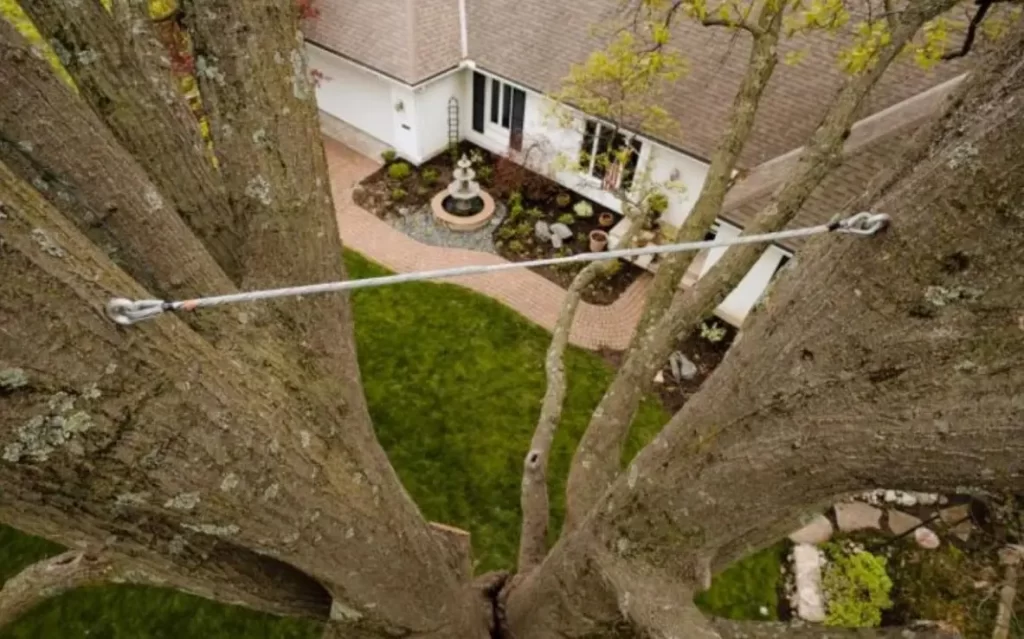
Cabling uses high-strength, flexible steel strands anchored between two limbs or between a limb and the trunk. By lifting and tying those sections together, we:
-
Redistribute load so one weak point doesn’t carry full weight
-
Reduce sway radius during wind events
-
Limit crack propagation along existing splits
Our crew installs each cable at least two-thirds up the crown to capture leverage, then pretensions hardware to industry torque specs. All anchor bolts meet ANSI A300 Part 3 standards, and we photograph every install for your records.
Curious how much sway reduction you’ll gain? Scroll past the next section for a quick visual.
When Tree Bracing Beats Cabling
Bracing targets the trunk itself. Threaded steel rods pass through a split or cavity, drawing the two halves into one rigid unit. We choose bracing when:
-
A vertical crack runs down the main stem
-
Two codominant leaders threaten to shear away
-
A lightning scar weakened central fibers
Bracing hardware carries zero stretch, so it arrests motion completely. After we tighten washers, the tree starts laying new tissue over the rods, adding strength season after season.
Our team never mixes systems randomly. In many cases, a hybrid—rod bracing low, flexible cabling high—delivers the safest outcome.
Decision Matrix: Cabling vs Bracing vs Removal
See the chart above for a quick comparison of risk reduction percentages we observe in the field. Full removal always eliminates hazard, yet it sacrifices shade and property value. Cabling and bracing each cut structural risk by more than half while preserving canopy coverage.
Step-by-Step: Our Structural Support Workflow
| Stage | What We Do | Typical Duration |
|---|---|---|
| 1. Diagnostic climb | Ascend with lanyards, tap limbs, probe bark, photograph unions | 30 min |
| 2. Load analysis | Measure limb diameter, spacing, and lever arms; choose hardware grade | 20 min |
| 3. Installation | Drill, set eye bolts or threaded rods, tension cables to spec | 90 min–3 hrs |
| 4. Final inspection | Shake test, tighten nuts, clip wire tails flush | 15 min |
| 5. Annual check-up | Re-inspect torque, adjust sling positions if growth overtakes | 30 min |
Preventive Care Schedule
-
Year 1: Recheck hardware after first spring storm.
-
Year 3: Loosen and retension cables to accommodate growth rings.
-
Year 5: Evaluate whether a second support set is needed higher in the crown.
-
Every hurricane threat: Call us for an express inspection; we clear deadwood in the same visit.
Bookmark our service page to track seasonal reminders, or follow updates on our Facebook project feed for before-and-after photos. Facebook
Sustainability Commitment
By preserving mature trees, we cut disposal emissions and keep roots in the soil matrix—critical for flood mitigation in Montgomery County’s clay-rich terrain. We chip only pruned material; larger sections become wildlife-shelter log piles donated to local parks. That practice aligns with the stewardship values highlighted on our gallery pages. Davis Tree LLC
Frequently Asked Questions
Q1. How long do steel cables last in Gulf-Coast humidity?
Galvanized strands hold their rated strength for 7–12 years before oxidation warrants change-out.
Q2. Does cabling stop limb drop during ice storms?
It reduces the odds dramatically by absorbing shock loads; however, extreme ice can exceed any engineered limit.
Q3. Can I mow under a braced trunk without hitting hardware?
Yes. Rods sit flush inside the wood; only small washers remain visible near eye level.
Q4. Will hardware harm the tree?
Trees compartmentalize around bolts and rods with little long-term impact when installed correctly.
Q5. Do you need city permits in Montgomery for cabling work?
Private residential lots outside designated historic zones require no permit for structural supports.
Q6. How soon after installation can kids play under the tree?
Immediately. Load transfer happens at the moment we tension hardware.
Q7. What’s the typical cost range?
Most cabling jobs fall between $450–$800; bracing with rods averages $350–$600, depending on diameter.
Q8. Can supports be removed later?
Yes. If the tree develops solid reaction wood, we can extract hardware and backfill holes with arbor-sealant.
Q9. Do you warranty your work?
Structural supports include a 24-month workmanship guarantee—hardware plus one complimentary inspection.
Q10. How do I schedule?
Use the quick form on our contact page or call 832-372-3686; we return estimates within one business day.
Need a second opinion? Reach out today, and let’s keep Montgomery’s canopy standing tall.